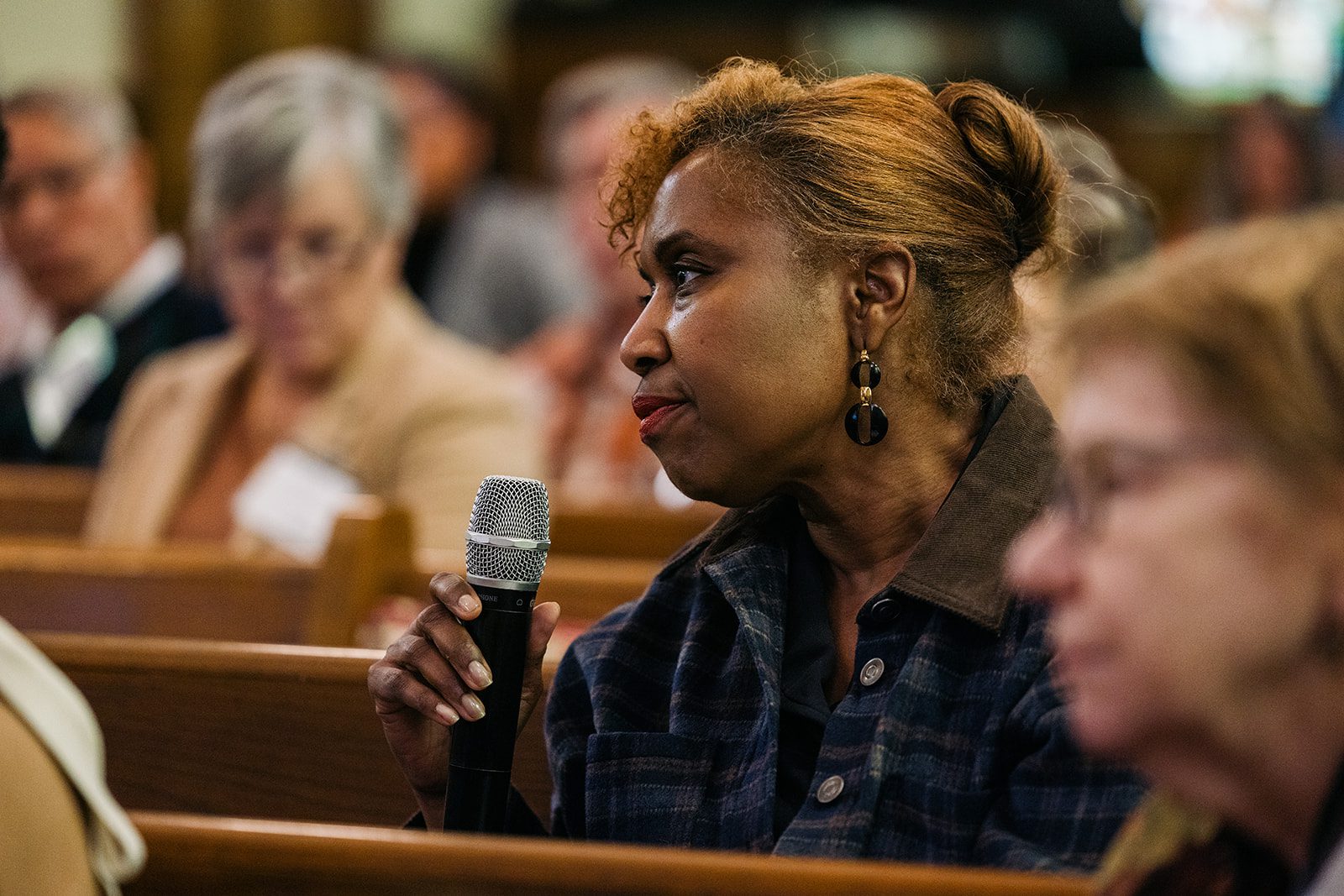
On October 30th, faith leaders, farmers, policy experts, and advocates gathered for “Nourish Our Future: Seeds of Hope for Kentucky,” a Bread for the World event in Frankfort, KY. Held at South Frankfort Presbyterian Church, the event brought together a cross-section of stakeholders to discuss agriculture, food access, and public policy in Kentucky.
Seeds of Hope for Kentucky was organized in collaboration with the Presbyterian Hunger Program, Cooperative Baptist Fellowship, Coleman Crest Farm, Henson Media, and Baptist Seminary of Kentucky (BSK) Theological Seminary. The event was spearheaded by one of Bread’s Senior Regional Organizers, Florence French Fagan, who covers the Southeast United States.
The goal of this gathering was to equip participants with a deeper understanding of food and farm systems in Kentucky, with an eye toward building constituent power and advocacy for systems change. In a year marked by significant cuts to the Supplemental Nutrition Assistance Program (SNAP) and Medicaid, and cuts to agricultural programs that supplied schools and food banks – and as the record-breaking government shutdown continued – this event was opportune to the policy moment we are in.
Rebecca Barnes, coordinator of the Presbyterian Hunger Program in Louisville, KY, shared a reflection as an attendee and planning member of the event. “This is such an essential time for us to come together, be together, and support strong action to end hunger in our community…across the state of Kentucky.”
The day opened with strong and encouraging pre-recorded remarks from Governor Andy Beshear. He recognized the commitment of attendees in caring for their neighbor by advocating for programs that hundreds of thousands of Kentuckians rely upon.
“Today is a great example of the incredible things that can happen when faith, government, and community leaders work together for a common goal.” The Governor continued, “My faith teaches me that food is life-giving and is meant to be shared. From the miracle of the fishes and the loaves to the last supper, we are called to feed and care for each other.”
Following the Governor’s remarks, the opening plenary framed how current policy decisions are impacting hunger and farming in Kentucky. Bread’s Managing Director, Rev. Heather Taylor, led a discussion with Jessica Klein of the Kentucky Center for Economic Policy, along with Jim Colemen, proprietor of Coleman Crest Farm outside Lexington, KY.
Throughout the day, each workshop approached the issue of hunger and food insecurity from a different angle. However, they all pointed to the same underlying truth: hunger is deeply connected to systems of power, equity, and opportunity, with poverty as a root cause. Participants could self-select into the following morning sessions:
- Bread’s Racial Wealth Gap Learning Simulation
- Why Innovation, Policy, and Faith Matter to Food Banks in Kentucky
- Food Sovereignty, Farming, and Land Access, and
- A film screening and discussion of the documentary, The Working Hungry
The film screening and discussion was led by Bread’s former board chair, Dave Miner.
The food banking panel included Charles Dennis, Executive Director of Feeding America Kentucky’s Heartland; Michele Carlisle, Executive Director of Amen House; and Dr. Mya O. Price, Assistant Professor at the George Washington University Global Food Institute.
The farming and land access panel featured Ashley C. Smith, Executive Director of Black Soil Kentucky, Jake McGowan of Earthrun Farm, and Maggie Dungan of Salad Days Farm.
Bread’s Racial Wealth Gap Learning Simulation was led by Florence French Fagan, who regularly holds simulations across the country for academic, legislative, faith, private, and non-profit audiences.
In the afternoon, attendees rejoined as a group to participate in a discussion with Congressional staffers from Senator Mitch McConnell’s (R – KY) and Senator Rand Paul’s (R – KY) offices. Rebecca Seidel, from Senator Paul’s office, and Robbin Taylor from Senator McConnell’s office both discussed the field office structure of their members, how to build relationships with field staff, and how to effectively communicate needs to their offices. Robbin shared that “Our Senators really appreciate it when they hear from Kentucky residents and value when their constituents share their stories in a respectful and constructive way.” Both staffers emphasized the importance of constituents calling or writing to raise an issue or concern. Rebecca reminded the audience that “staff are people too”.
The day ended with an Advocacy 101 training, led by Pastor Alex Lockridge of First Baptist Church of Corbin, in Corbin, KY. He led participants through the basics of advocacy and organizing, and led them through an Offering of Letters, where participants wrote to their Members of Congress urging them to protect SNAP funding. As the day closed at Seeds of Hope for Kentucky, Florence reminded those in attendance that “…we truly planted hundreds of seeds—not only of hope, but of concrete action—laying the foundation for a growing team of Kentuckians who will continue organizing and supporting one another in their communities.”
Now that those seeds are planted, it’s up to all of us to work with our communities, especially our churches, to enact enduring change that will end hunger in our communities.
Taylor Johnson is a Domestic Policy Advisor at the Policy and Research Institute (PRI) at Bread for the World.
Deepen your understanding of hunger’s causes and solutions – join our Institute Insights community and receive free, research-based articles like this one straight to your inbox.
Join Our Community
Related Resources
What Does Voting Have to Do with Ending Hunger?
Hunger often seems like too daunting a problem to solve, with nearly one in 11 people around the world going...
Renewing America’s Leadership in Global Food Security
As we remember the one-year anniversary of the closure of USAID, and the transfer of development and humanitarian...