By Philippe Lazaro, Plant with Purpose
In Burundi, a small landlocked country in East Africa, far too many people struggle to feed their families. The Food and Agriculture Organization (FAO) reported that in the first quarter of 2025, 1.2 million people in Burundi faced acute food insecurity in a population of 14.4 million.
Bread for the World members continue to advocate steadfastly for assistance for development and climate change adaptation. The goal is to better equip families and communities to provide for themselves and their children through support in areas such as nutrition, agriculture, and health.
Chronic hunger is also widespread in Burundi. In some regions, more than half of the children under 5 are affected by stunting, which causes permanent damage to human physical and cognitive development.
Burundi is also highly vulnerable to climate impacts. According to the Notre Dame Global Adaptation Initiative, Burundi is one of the most vulnerable and least prepared nations in climate adaptation.
Kamariza, a participant in Plant with Purpose’s program in Burundi and a mother of six in Mugere, Burundi, knows firsthand what the statistics mean. She holds memories of the time her land betrayed her.
Without tree roots or proper contours to help retain the soil, the rains swept away vital nutrients every year. “The infertility of the soil was caused by erosion due to poor management of our land,” she recalls. “It was difficult to find enough to eat.”
Most Burundians are smallholder farmers who confront similar problems. Farms have low yields and are vulnerable to shocks. Thus far in 2025, a poor harvest season means inadequate cereal production and higher prices for maize and beans.
The consequences for a household are stark. “Our children were malnourished and only ate once or twice a day,” Kamariza recalls. “I would borrow money from friends without my husband knowing, and this often led to family conflict.” Beyond a lack of calories and nutrients, hunger strains relationships, dignity, and hope.
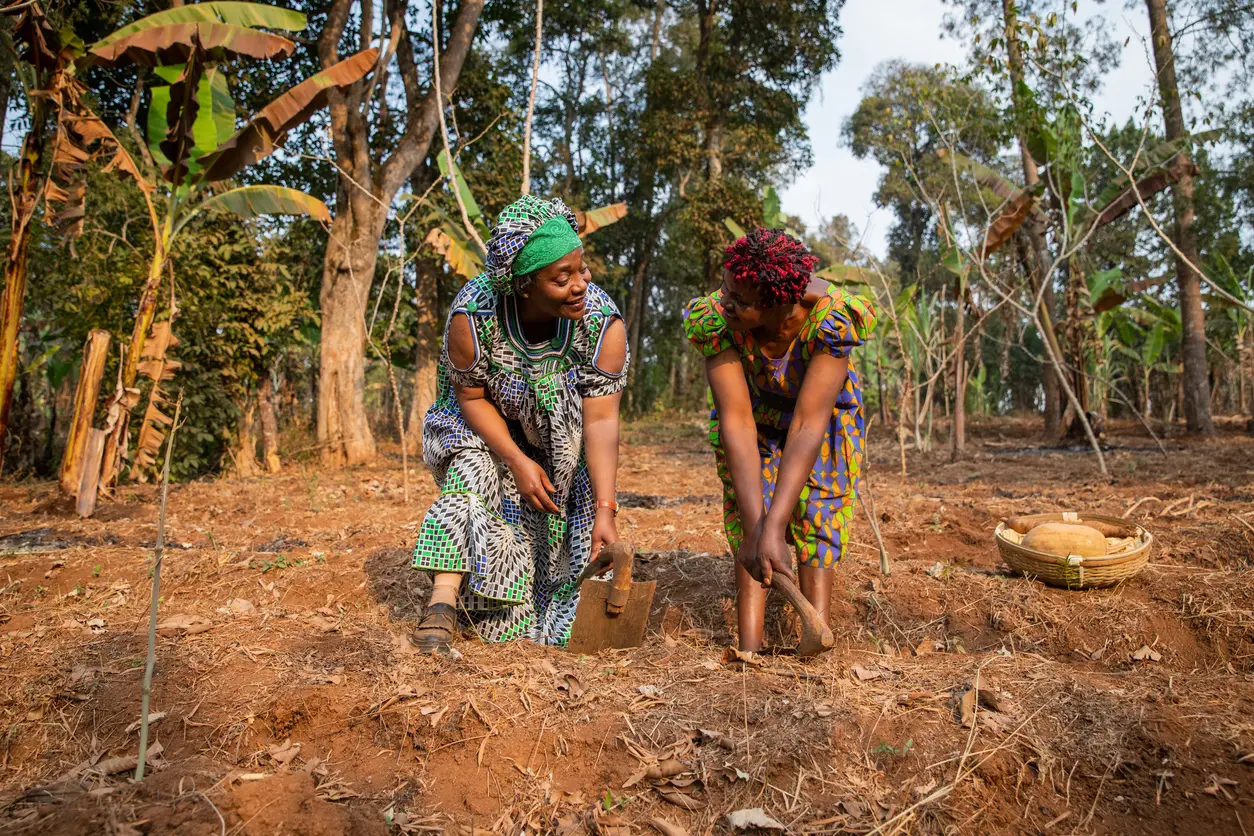
Kamariza’s moment of change came when she joined a Purpose Group supported by Plant with Purpose. These community-based groups combine financial empowerment with training in regenerative agriculture. Farmers learn soil conservation and agroforestry—for example, how to integrate trees into their fields.
“We were taught how to manage our steep, deforested land,” Kamariza shares. “Today, we farm according to the training, which really helps us farm for a lot more income.”
The changes on her land mirrored program-wide results. Globally, Plant with Purpose projects have produced a 28 percent improvement in soil health. Even land in very poor condition can benefit: from the same report, in the Democratic Republic of the Congo (DRC), Burundi’s neighbor to the west, similar interventions produced a 99 percent improvement in soil health.
These practices are low-cost and highly adaptable, and they yield long-term benefits. Kamariza can see the results every day in her home. “Our children eat three or four times a day. We even bought a solar panel so they can do their homework at night.”
Kamariza’s story is a case study in the role regenerative agriculture can play in bolstering food security. The benefits are not just agricultural, but economic, social, and environmental.
Contour farming, use of organic fertilizers, and agroforestry improve yields and reduce hunger for families like Kamariza’s. Better soil and water retention also support adaptation to climate impacts such as erratic rainfall.
The added income, paired with access to credit, offers better economic opportunities to small farmers. Purpose Groups include a savings and loan component, whose established participants are twice as likely to save money as non-participants.
Group-based approaches also nurture cooperation in communities. In Plant with Purpose’s Mexico programs, 75 percent of participants report that they solve problems as a community. Similar dynamics emerge in Burundi, particularly in conflict resolution.
Policymakers can clearly see a significant return on investment. These strategies pay for themselves many times over. For example, the World Bank’s Colline Climate Resistance Project documented a rate of return of 36 percent over 15 years of a watershed restoration project.
Investing in women like Kamariza creates a multiplier effect: in turn, women pass benefits along to their families and communities.
“Thanks to the Purpose Group,” Kamariza says, “paying school fees for my children is no longer an issue.” She reinvested in livestock, planted fruit trees, and now teaches her children that “work is a blessing from God.”
In Burundi, churches are trusted institutions. Integrating faith communities into sustainability programs can also help assure the project’s success. Moreover, the work of Plant with Purpose in nine countries where churches play an active role affirms that faith can be central to how communities organize around change.
Key elements of the success of Plant with Purpose in Burundi include training women in regenerative agriculture and agroforestry, integrating rural faith communities, promoting savings and access to credit, and supporting the leadership of communities themselves.
Kamariza’s success in applying new approaches and techniques to benefit her family is inspiring, but her story does not have to be an exception. Rather, it shows what is possible when regenerative agriculture, food security, and faith intersect. In Burundi and other places where climate change and poverty converge, these lessons are urgent.
Philippe Lazaro is communications manager for Plant with Purpose, a Christian nonprofit organization working in nine countries to support rural communities in their efforts to solve the interdependent problems of poverty and environmental degradation.
Deepen your understanding of hunger’s causes and solutions – join our Institute Insights community and receive free, research-based articles like this one straight to your inbox.
Join Our Community
Related Resources

Pursuing Global Collaboration to End Insecurity and Hunger Caused by Climate Change
In November 2025, the 30th annual U.N. Climate Change Conference, better known as COP30, took place in Belem,...

Legislative Moments that Shaped Agriculture, Climate, and Food Security in 2025
Food Loss and Waste This year, two measures to reduce food loss and waste were reintroduced in both...