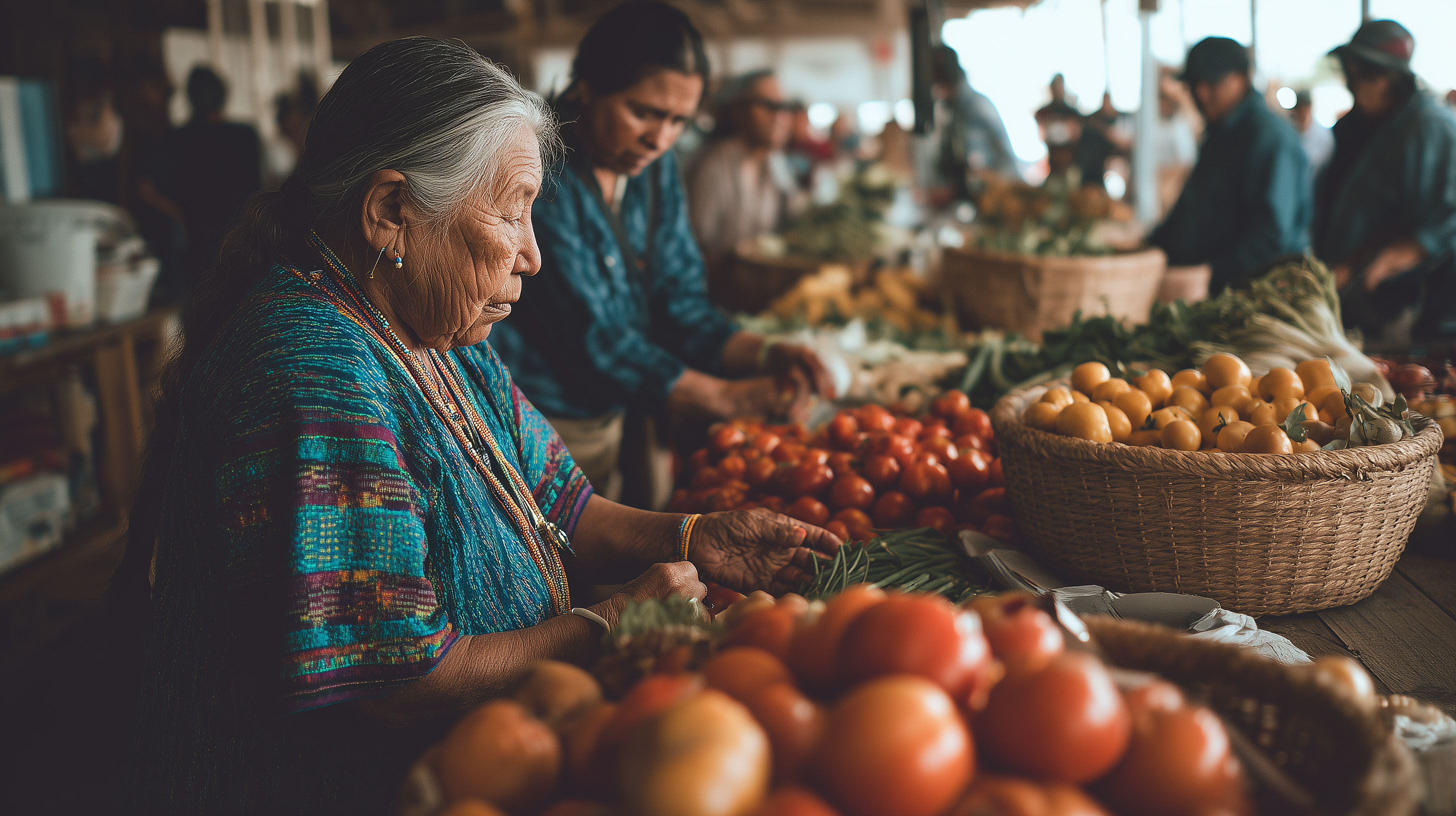
On a late July day, two generations of people of the Choctaw Nation sow seeds across Mississippi soil. The seeds will eventually grow into Iron Clay Peas, a cover crop that is resistant to drought and, as they mature, help build the soil’s resistance to erosion. Within weeks, the peas will have helped prepare the soil bed within the greenhouse of Choctaw Fresh Produce’s organic farm to grow fresh produce for the residents of the Mississippi Band of Choctaw Indians Reservation. Choctaw Fresh Produce, commonly known as Choctaw Fresh, is a farming project that grows, delivers, and sells organic foods to local residents and businesses.
Bread for the World members have for decades advocated for federal nutrition programs that enable families all around the country to put food on the table. A harsh reality is that rural households have higher rates of food insecurity than the national average. Rural grocery stores have difficulty stocking a variety of affordable and nutritious foods. Similarly, rural households face challenges in accessing grocery stores that offer healthy and fresh foods because the stores can be a long distance away and often have higher prices. Children have a difficult time coping with food shortages at home.
Many Native Americans living on reservations and Tribal communities face these situations. A 2014 report from the U.S. Department of Agriculture (USDA) found that the share of Tribal households without a vehicle and located more than a mile away from a supermarket (65 percent) was significantly higher than that of non-Tribal households with the same geographic characteristics (20 percent). Another obstacle is that, although many Native Americans who live on reservations are eligible to participate in SNAP, participants can only redeem their benefits at USDA authorized retailers, which can be scarce in and around reservations.
A recent webinar from Food Systems for the Future highlighted this specific challenge and featured a fourth-generation independent grocer in South Dakota who serves a Tribal community. R.F. Buche, who is the president of Buche Foods, explained that all of his grocery locations are on or near Native American reservations in South Dakota, and that SNAP redemptions account for up to 60 percent of sales at some locations.
In place of SNAP, many reservations operate FDPIR, or the Food Distribution Program on Indian Reservations. Around 55,000 households participate in FDPIR—about 10,000 more than just three years ago. The USDA Food and Nutrition Service (FNS) and Agricultural Marketing Service (AMS) collaborate to purchase and distribute foods for FDPIR. USDA piloted the FDPIR Self-Determination Demonstration Projects, also referred to as “638” demonstration projects. Authorized by the 2018 farm bill, these projects grant Tribal Nations the authority to purchase from commercial vendors of their choice, such as Choctaw Fresh, which prioritizes organic growing methods, community resilience, and healthy food access.
“… Choctaw Fresh gives people the ability to utilize our mobile market and put farms in certain areas, which means we’re able to reach those people that live in scarce areas that aren’t able to have access to eating healthy,” stated Tomika Bell, a distribution manager at Choctaw Fresh, in an interview with Modern Farmer.
These demonstration projects also allow Tribal Nations to invest in their local and regional economies across Indian Country. Nigel Gibson, a Tribal Council Member of the Mississippi Band of Choctaw Indians, commented to Modern Farmer about the dual benefits of the “638” demonstration projects. “…the pilot [projects] aren’t only improving health and nutrition – they also help boost local economies and livelihoods if properly supported.”
In November 2023, Institute Insights published another piece on how FDPIR is being implemented that focuses specifically on Sioux reservations.
The “638” demonstration projects were originally authorized for five years after Congress passed the 2018 farm bill. They are subject to line-item funding – which means Congress must appropriate funding specifically for these projects to continue. The uncertainty of both funding and program continuity creates uncertainty for Native business operators who participate in the program. As a result, groups like the Native Farm Bill Coalition have called for Congress to permanently authorize the “638” demonstration projects, which would enable them to continue uninterrupted.
Including improvements in a new farm bill could prove difficult because this legislation has stalled in Congress. Luckily, Representative Sharice Davids (KS-03), Representative Frank Lucas (OK-03) and Representative Tom Cole (OK-04) have introduced a separate bill to make permanent the ability of the USDA to enter into self-determination contracts with Tribal entities to administer FDPIR, similar to the “638” demonstration projects. This is captured in the Food Distribution Program on Indian Reservations Act of 2025 (FDPIR Act of 2025), introduced in June.
“To be able to expand like that would not only give us opportunities food-wise within the community, but it also could give us [economic] help within the community because when you expand, you’re able to provide more job opportunities,” Tribal Council Member Nigel Gibson said in a comment about funding for the “638” projects.
When local communities are included in decision-making and implementation, they often invest back into their communities — meeting local challenges with local solutions. Passing the FDPIR Act of 2025 would be a first step in ensuring that these critical demonstration projects can scale up and become permanent.
Isabel Vander Molen is a climate-hunger policy advisor, Policy and Research Institute, with Bread for the World.
Deepen your understanding of hunger’s causes and solutions – join our Institute Insights community and receive free, research-based articles like this one straight to your inbox.
Join Our Community
Related Resources

WORKING TOGETHER TO END HUNGER: 2025 Legislative and Policy Achievements
A series of administrative and congressional actions this year dealt devastating blows to the United States’ international assistance...
Less Food Waste Means a More Effective Food System
Bread for the World emphasizes that an effective food system gets food from farm to table while prioritizing...