By Michele Learner, Bread for the World Institute
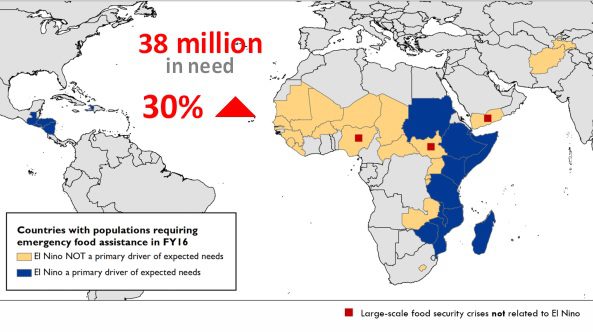
El Niño is a natural phenomenon — a warming of the Pacific Ocean that happens every few years – but climate change is worsening its effects. This year’s El Niño is the strongest on record and has left at least 30 million people without reliable access to food. Altogether, more than a dozen countries have been affected.
El Niño has exacerbated the already severe drought in southern Africa. The U.S. National Oceanic and Atmospheric Administration (NOAA, part of the Commerce Department) says that El Niño has been weakening since April 2016, but its effects continue. According to the U.S. Office of Foreign Disaster Assistance, in fact, poor conditions in southern African countries are expected to persist through April 2017. Malnutrition as well as crop failure, water scarcity, and precarious conditions for livestock are part of the fallout.
U.S. ambassadors or charge d’affaires have formally declared disaster conditions in Mozambique, Swaziland, Zimbabwe, Lesotho, Malawi, and Madagascar. Other victims of the severe weather live in Zimbabwe, Namibia, and Ethiopia.
The regional organization SADC (Southern African Development Community) has deployed teams to assess post-harvest conditions. They found that throughout the region, harvest failures are contributing to higher food prices. With fewer jobs as hired farm laborers available, food has become prohibitively expensive. As Bread for the World Institute explained during the global food price crisis of 2007-2008, the sudden spikes in the prices of staple crops and the price volatility that has become the “new normal” since then lead to families being forced to pull their children out of school to help earn a living, sell their livestock at below-market rates before the animals become sick or die, or use other types of “negative coping strategies.”
USAID reports that so far in 2016, it has provided nearly $75 million in humanitarian assistance to countries in southern Africa to help them respond to drought and food insecurity. The assistance includes both distributing food to vulnerable families and providing them with seeds and other necessities for the upcoming planting season.
Please see this USAID resource for more information about how to help directly.
Michele Learner is associate editor at Bread for the World Institute.
Related Resources
Breaking the Cycle: Hunger, Debt, and Climate in the Global South
Every day, millions struggle to put food on the table. In many developing countries, smallholder farmers watch their...
How Humanitarian Assistance Saves Lives
When global catastrophes strike, whether through conflict, natural disasters, or disease, communities find themselves without the most basic...