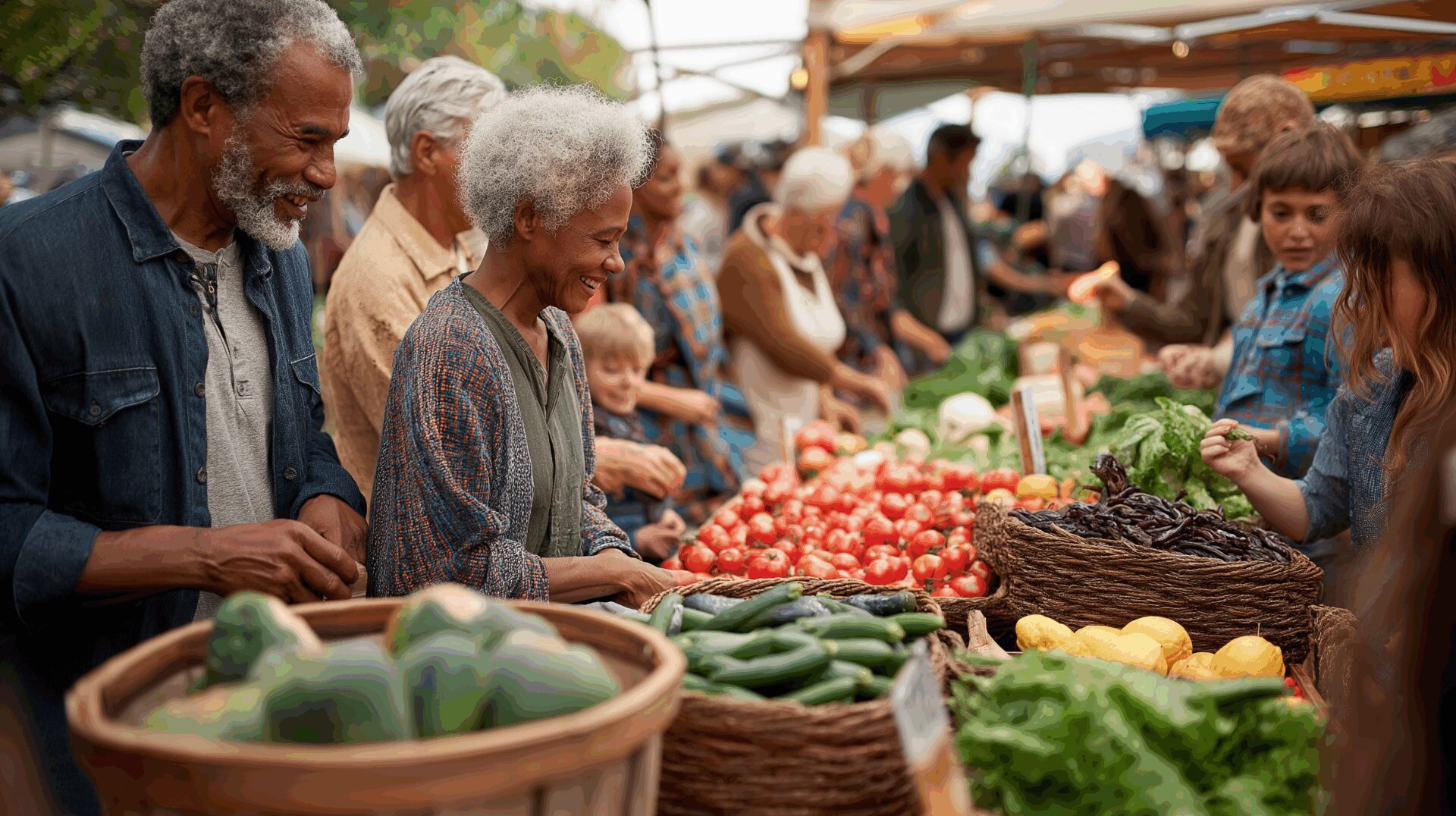
Mid-summer brings heat, humidity, and an abundance of produce with ripe scents and vivid colors. A stroll through the farmers market in July is like standing before a brightly colored quilt where each stall contributes to the tapestry. Squash, in brilliant yellow, contrasts with the emerald green of its zucchini cousins. Heirloom tomatoes streaked with shades of burgundy and crimson sit beside crisp cucumbers. Peaches and melons perfume the air with an almost syrupy sweetness.
Beyond this sensory appeal, farmers markets and other direct entities, such as community-supported agriculture initiatives (CSAs), are vital both to Americans’ health and the nation’s agriculture sector. At their best, farmers markets and CSAs can increase access to fresh, local produce for the whole community, especially when partnered with federal nutrition programs.
In the Agricultural Improvement Act of 2018, aka the farm bill, Congress authorized the U.S. Department of Agriculture (USDA) to promote direct sales to consumers through the Farmers Market Promotion Program (FMPP). The program is still authorized through the American Relief Act of 2024. At this writing in July 2025, grant applications funded by the FMPP are still being accepted.
Direct-to-consumer sales are especially important for newly established and small-scale farms, as well as farms owned by people of color and/or women. Compared with all U.S. farms, producers who sell directly are more likely to be female and more likely to be younger (in the category “under 35”). Data from the 2022 Census of Agriculture showed that more than 147,000 U.S. farms had direct farm sale operations. Approximately 78 percent of them sold all of their directly-marketed food within a 100-mile radius of the farm. This is significant given that “local” can mean up to 400 miles away.
Farmers markets aren’t just beneficial to farmers, however. They are powerful structures in addressing food insecurity and improving health outcomes, especially where grocery stores are scarce, public transit is limited, and systemic disinvestment has long undermined access to fresh food. In FY 2023, nearly 7,000 farmers markets and farmers who could accept SNAP benefits generated $71 million in food and produce sales, via 2.7 million SNAP EBT transactions.
The Gus Schumacher Nutrition Incentive Program, or GusNIP, also plays a crucial role in bridging access to farmers markets for SNAP participants. GusNIP provides additional resources to purchase fresh fruits and vegetables by doubling the value of SNAP dollars that can be spent at farmers markets. Through the Double Up Food Bucks program, SNAP participants can match up to $20 in benefits and redeem up to $40 in local produce purchases. In 2021, GusNIP funded $9 million worth of fresh produce purchases at farmers markets and direct marketing farms. These dollars not only strengthen the food budgets of low-income families but also support local agricultural economies.
In addition to SNAP, the Farmers Market Nutrition Program (FMNP) provides benefits to WIC participants and low-income seniors. In FY 2022, more than 2 million WIC participants and seniors received FMNP benefits, allowing them to purchase nutritious local produce. Programs like Pennsylvania’s Farm-to-WIC “grab bag” or Michigan’s Senior Project Fresh have increased benefit redemption and participation among both groups. Altogether, in FY2023, the USDA Food and Nutrition Service (FNS) provided $64.2 million in WIC and Senior FMPP grants across nearly all states, U.S. territories, and several Tribal Nations, and facilitated $92 million in direct-farm and GusNIP redemptions. (See WIC and Senior FMNP grants).
While the economic argument for farmers markets is strong, there is more to the picture. When families and individuals participating in federal nutrition programs redeem their benefits at farmers markets, their health and well-being can improve too. The redemption of SNAP benefits at markets is positively associated with increased fruit and vegetable consumption. The same pattern is observed in WIC FMNP participation, especially among Black women in historically marginalized communities. For seniors, markets not only boost produce consumption, but also offer additional opportunities for social contact—in itself a key contributor to people’s overall health.
Farmers markets and other direct market opportunities are essential to improving Americans’ health. They make nutrition security a key element of a more resilient and equitable food system. When paired with robust federal programs, they are a direct way of getting fresh, healthy food to families who need it most while supporting local and regional farms.
At Bread, we have advocated for Congress to reauthorize the farm bill. Congress should resume negotiations and ensure that the final version includes expanded support for farmers markets and other sources of fresh fruits and vegetables. This is essential to healthier communities, stronger local economies, and a food system that works for everyone.
Taylor Johnson is a domestic policy advisor, Policy and Research Institute, with Bread for the World.
Deepen your understanding of hunger’s causes and solutions – join our Institute Insights community and receive free, research-based articles like this one straight to your inbox.
Join Our Community
Related Resources
Implications of this Year’s Rapid Changes in U.S. Nutrition Policy
This year, Congress and the Executive Branch, specifically the U.S. Department of Agriculture, have passed laws and used...

Helping Hungry People and Healing the Land: Regenerative Agriculture in Burundi
By Philippe Lazaro, Plant with Purpose In Burundi, a small landlocked country in East Africa, far too many...