By Annie Muawad
The aphorism “an apple a day keeps the doctor away,” was coined in 1866 in Pembrokeshire, Wales, and is still resonant today. It reflects a truth recognized across cultures and generations – nutrition matters. For millions of children around the world, however, access to nutritious food remains out of reach.
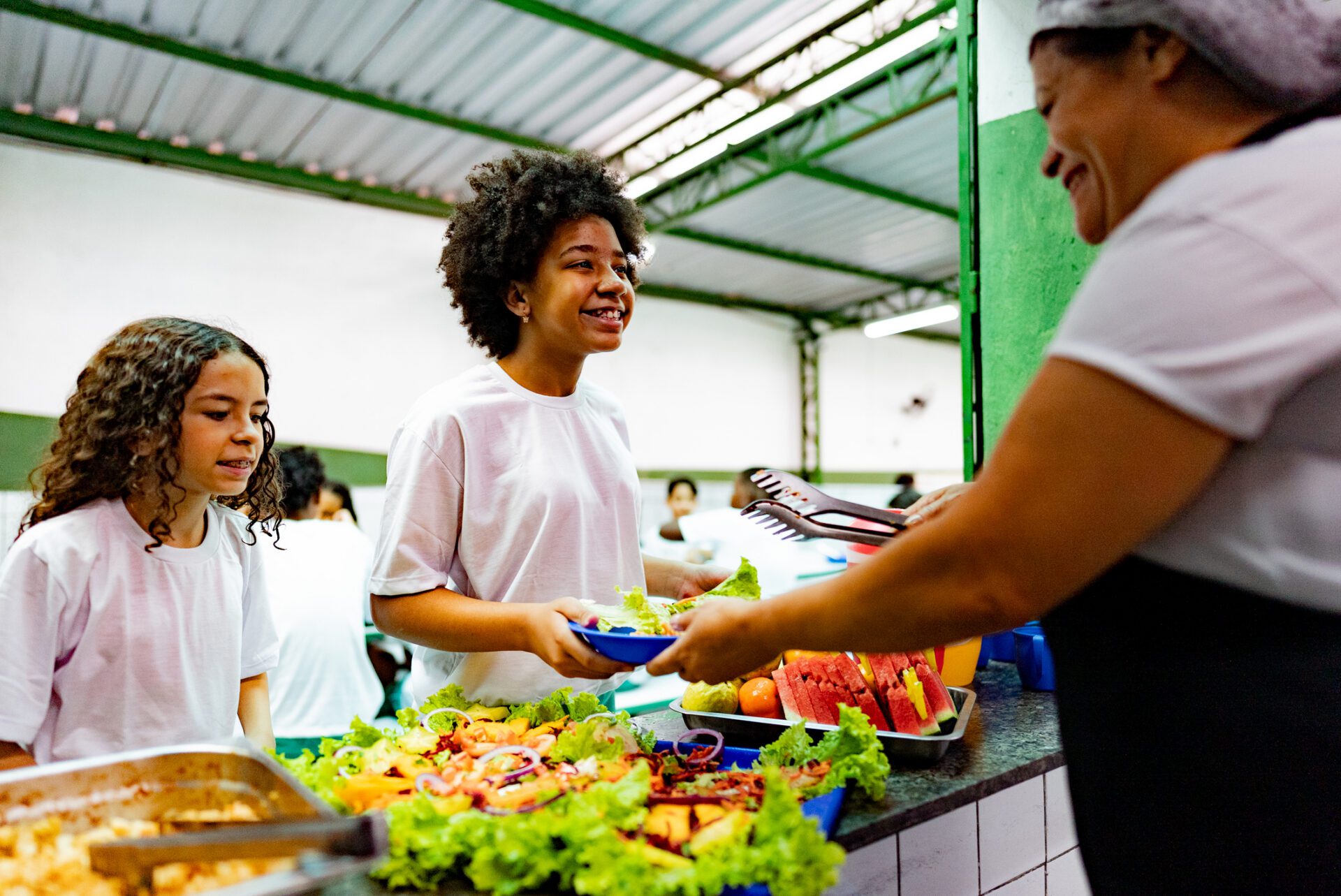
School feeding programs are effective models for nourishing children and represent one of the largest social safety nets in the world. For more than two decades, the United States has invested in global school meal access through the McGovern-Dole International Food for Education and Child Nutrition Program. This program is administered by the U.S. Department of Agriculture’s Foreign Agricultural Service (FAS). By providing school meals in low-income, food deficit countries, McGovern-Dole improves nutrition and educational outcomes for children, supports local economies, and advances U.S. agricultural and foreign policy interests. McGovern-Dole helps to improve child nutrition outcomes while delivering measurable benefits for students, families, communities, and American farmers. while delivering measurable benefits for students, families, communities, and American farmers.
School Feeding Programs Support School Performance and Local Farmers
Participation in school meal programs can help children consume half of their daily caloric needs and critical micronutrients that help to reduce the risk of diet-related diseases. School meals can also help to reduce the prevalence of anemia, especially in adolescent girls who receive micronutrient fortified school meals. Beyond nutrition, school feeding programs also bolster attendance, academic performance, and market access for local farmers. For example, school enrollment rates increase, on average, by up to nine percent when students and families know they will receive a meal at school. Additionally, daily attendance can increase by 8-10 percent, with children who receive school meals attending school roughly one extra day every two weeks.
Local farmers and producers can also benefit from school meal programs through increased market access. Globally, 57 percent of school meal programs have an explicit objective to help smallholder farmers gain access to a predictable market. Across regions, school meal programs in Sub-Saharan Africa (75%) and South Asia, East Asia, and the Pacific (65%) had the most engagement with farmers. In Brazil, the country government mandated that at least 30 percent of school meal funds go to family farms, with an explicit focus on women and local producers.
Why School Feeding Has Become a Global Priority
Globally, at least 169 countries, or roughly 87 percent of all nations, have formalized national school feeding policies. However, millions of children still lack regular access to them. Higher-income countries reach about 62-80 percent of primary school children, while lower-income countries reach roughly a quarter of school children. National budgets, rather than external donors, are responsible for financing the majority of these programs, with total funding roughly doubling from $43 billion in 2020 to $84 billion in 2024. Sustained funding and expanded access in lower-income countries is a critical priority that programs like McGovern-Dole help to achieve.
The Critical Role of the McGovern-Dole Program
Since 2003, more than 40 million infants, children, pregnant and nursing women and school community members have benefited from the McGovern-Dole program. In Cambodia alone, the benefits of McGovern-Dole projects have reached 121,500 students, including 61,500 girls, across 448 primary schools. The program exceeded its output targets on improved student attentiveness and reduced hunger, and it contributed to modest gains in attendance and reductions in health-related absences. In Fiscal Year (FY) 2023, McGovern-Dole benefited 5,000 schools across Africa, reaching more than 2.9 million beneficiaries. For FY2026, the McGovern-Dole program will award up to $240 million in new cooperative agreements in priority countries Bolivia, Ecuador, Guinea (Conakry), Honduras, Liberia, and Timor-Leste. These investments build on the program’s longstanding legacy and demonstrate U.S. leadership in global food security at its best.
Why Congress Must Continue Investing in McGovern-Dole
In the U.S. and around the world, school feeding programs are an important part of the solution to hunger, especially for children. Whether viewed through the lens of education, foreign interests, agriculture, or economic development, school meals remain one of the most effective tools for ending hunger and creating opportunity. Bread for the World has long advocated for robust congressional investment in the McGovern-Dole Program. Through its Nourish Our Future Campaign, Bread calls for strengthening proven global nutrition and food security programs that help reduce hunger and improve outcomes for vulnerable children and communities. Bread remains committed to this advocacy and will continue championing McGovern-Dole as a critical tool in the fight to end global hunger for years to come.
Annie Muawad is an International Policy Research Intern at Bread for the World’s Policy and Research Institute (PRI).
Related Resources
Healthy Mothers, Healthy Babies: How Nutrition and Health Services Save Lives
By Katie Garcia When families gather to celebrate holidays, we remember that nutritious food does more than sustain...
Enough Food at the Table? How SNAP Cuts are Impacting Food...
By Taylor Johnson In the days leading up to Thanksgiving, many grocery store shelves are increasingly bare as...